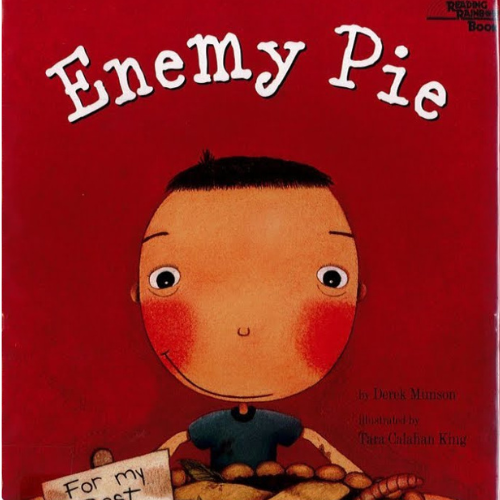
Enemy Pie
Average Rating: 0.0
Country: USA
Ages: 5-8,8-10
Author: Derek Munson
Publisher: Chronicle Books
Illustrator: Tara Calahan King
Story Source: Storyline Online

About The Story

When a new boy named Jeremy Ross moves into the neighborhood, the narrator is quick to label him his No. 1 enemy—especially after being left out. Hoping for revenge, he tells his father, who offers to make his mysterious “Enemy Pie”, to solve the problem. But there's a catch: to make the pie work, he must spend a whole day being nice to Jeremy. As the boys spend the day together—playing, laughing, and discovering common ground—the narrator begins to question whether Jeremy was really an enemy. In the end, the pie is just a decoy... and the lesson is real. This clever, heartfelt story serves up big messages about assumptions, empathy, and the magic of shared time. This story pairs beautifully with other Zamasama stories on friendship and conflict: • The Grand Patch-Up – about a misunderstanding that almost ends a friendship • The Sweetest Mango – a tender reminder that some things, like mangoes and friendships, are sweetest when shared

Themes

Family & Friends
Inclusion & Disability
Social & Emotional Learning

Sub Themes

Acceptance & Inclusion
Conflict Resolution

Parent-Teacher Guide

Learning Outcome

  • Students learn how quick assumptions can turn others into enemies
  • The story shows how shared experiences help break misunderstandings.
  • Children understand that feelings like jealousy and exclusion are natural.
  • Students are encouraged to choose kindness and openness to build friendships.
  • The lesson highlights the power of empathy, time, and connection in relationships.

Lesson Plan

  • Often, a problem is not of the other person—it’s the story we tell ourselves about them.
  • When we take time to listen, play, and connect, we discover our shared humanity.
Activities

  • Friendship Recipe Activity– Students create their own “Friendship Pie” recipe using emotional ingredients (e.g., “a cup of kindness, ” “two spoonfuls of laughter”)
  • Compare & Contrast: Enemies vs. Friends – Use a Venn diagram to compare how people act when they are enemies vs. friends. Add real-world examples.
  • Secret Recipe for Peace (SDG Extension) – Have students brainstorm their own ideas to help classmates, schools, or neighborhoods become more peaceful.
  • Role-Play: From Enemy to Ally– Act out scenarios where misunderstandings create conflict, then explore how time, kindness, or conversation could turn things around.
Story Discussion Guide

Before reading

  • What is an “enemy”? Have you ever felt like someone was your enemy?
  • What’s the difference between being someone’s enemy and someone’s friend?
  • If you were going to make an 'enemy pie' , what would you put in it?

During reading

  • Why do you think the narrator dislikes Jeremy?
  • What do you notice changing as they spend time together?
  • Why doesn’t the narrator want Jeremy to eat the pie anymore?
  • Why do you think it’s still called “Enemy Pie”?

After reading

  • What was the problem in the story, and how was it solved?
  • How did the narrator’s feelings about Jeremy change?
  • Do you think they would have become friends without the pie?
  • Wherever in the world we live—don’t we all want the same things: to be liked, to have fun, to belong?

Applicable Sustainable Development Goals

SDG 3 — Good Health and Well-being

Good Health and Well-being: Social-emotional learning and relationship building

SDG 4 – Quality Education

Quality Education: Learning through literature and personal reflection

SDG 16 — Peace, Justice & Strong Institutions

Peace, Justice, and Strong Institutions: Promoting inclusion and peaceful interaction

Comments

There are no comments

Leave a Reply

Sign up to receive notifications whenever we
release new books

Share this post
Start typing and press Enter to search

Shopping Cart
Sign up with Google